
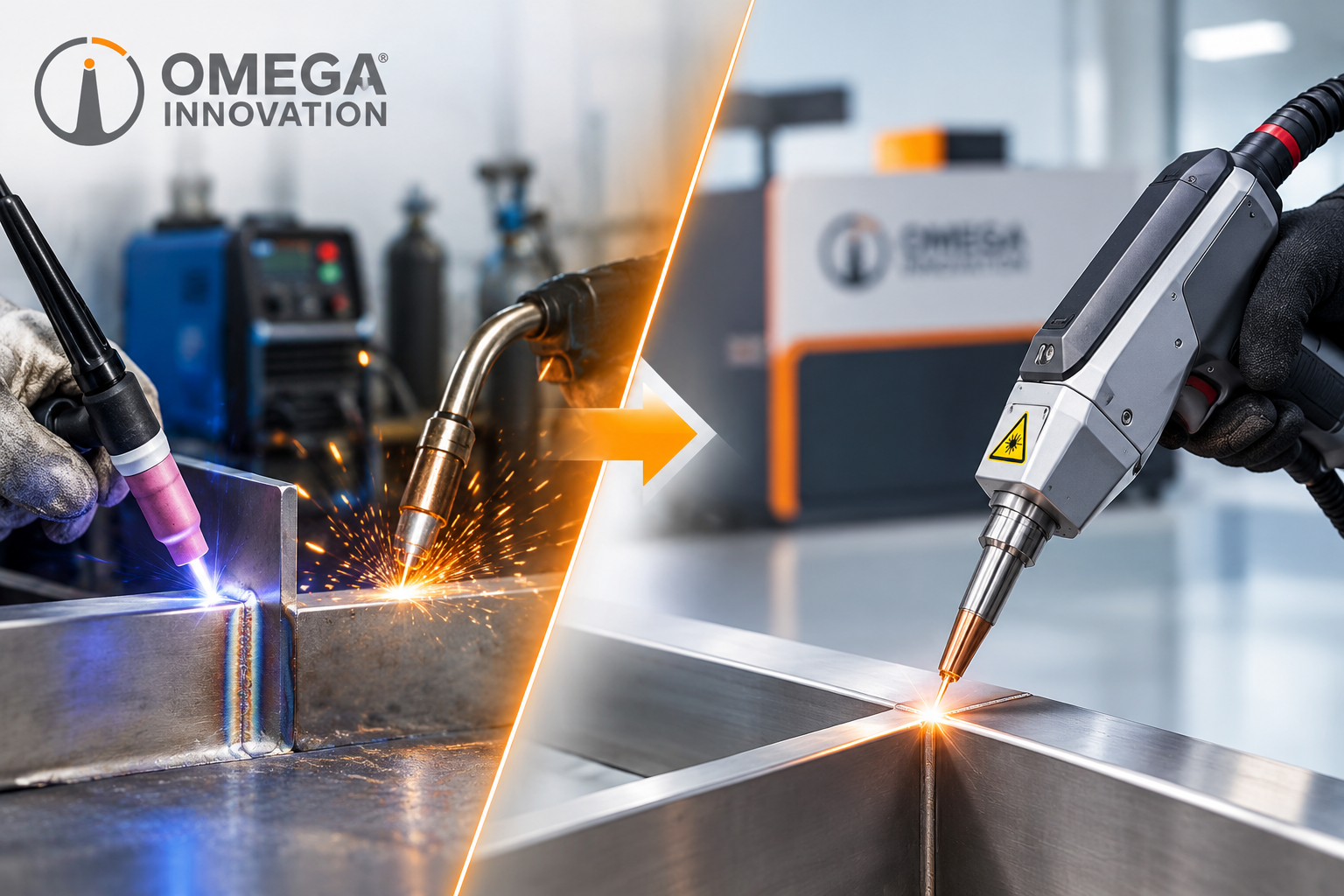
For decades, TIG and MIG welding have been the default choice on fabrication floors - reliable, well understood, and backed by a large pool of trained welders. But over the past few years, handheld laser welding has moved from a niche, expensive novelty to a genuinely competitive alternative that many shops are now choosing over conventional arc welding processes.
This shift isn't happening because handheld laser welding is trendy. It's happening because it solves specific, expensive problems that TIG and MIG have never fully resolved: welder skill dependency, heat distortion, finishing time, and inconsistent quality across operators. This article looks at what's actually driving the switch, where TIG and MIG still hold their ground, and what to consider before making the move.
1. The Core Limitations of TIG and MIG Welding
TIG welding produces high-quality welds but is slow, requires significant operator skill, and is physically demanding over long shifts - making consistent output hard to sustain across a full workforce. MIG welding is faster and easier to learn than TIG, but it introduces spatter, higher heat input, and often requires grinding or finishing work before a part is presentable or paint-ready.
Both processes are also highly operator-dependent. Weld quality on a TIG or MIG job can vary noticeably between a shop's most experienced welder and a newer hire, which creates quality control challenges, especially for shops serving customers with tight cosmetic or structural tolerances.
2. How Handheld Laser Welding Works
A handheld laser welding machine delivers a focused laser beam through a lightweight, cable-fed welding gun operated manually, similar in form factor to a MIG torch. The laser beam melts the base metal (with or without filler wire, depending on the joint) to form the weld, guided by the operator's hand movement along the joint line.
Because the beam is generated by a fiber laser source rather than an electric arc, the heat-affected zone is narrower, the energy delivery is more controlled, and the process produces far less spatter than MIG or the visible arc glare associated with TIG.
3. Speed: The Most Obvious Difference
Handheld laser welding typically completes a joint several times faster than TIG welding on comparable material and joint types, and noticeably faster than MIG in most sheet metal applications. For shops billing on throughput or running high part volumes, this speed difference compounds quickly across a production run, directly affecting labor cost per part and overall shop capacity.
4. Weld Quality and Reduced Post-Processing
One of the most commercially significant advantages of handheld laser welding is the reduction in post-weld finishing work.
• Minimal spatter: Unlike MIG, laser welding produces little to no spatter, cutting down or eliminating grinding and cleanup time.
• Smoother weld bead: Welds often require little to no additional finishing before painting or polishing, compared to TIG or MIG seams that frequently need grinding for a clean, presentable surface.
• Consistent bead appearance: Because the process is less dependent on manual torch angle and travel speed variation, bead consistency improves across a production run.
For shops selling cosmetic or customer-facing fabricated parts - railings, enclosures, furniture, appliance panels - this reduction in finishing labor often has as much financial impact as the welding speed itself.
5. Heat Input and Distortion Control
Laser welding delivers a narrower, more concentrated heat zone than TIG or MIG arcs. On thin sheet metal in particular, this significantly reduces warping and heat distortion - a common headache in TIG and MIG welding that often requires extra clamping, sequencing strategies, or straightening work afterward.
This makes handheld laser welding particularly attractive for thin-gauge stainless steel and aluminum fabrication, where heat distortion has traditionally been one of the hardest problems to manage with conventional arc welding.
6. Skill Dependency: Why Laser Welding Shortens the Learning Curve
TIG welding, in particular, can take years to master to a professional standard, and even MIG welding requires meaningful practice to achieve consistent, presentable beads. Handheld laser welding machines are generally easier to learn, since the process is more forgiving of minor hand-speed and angle variation than a manual arc process.
This matters directly for workforce planning. Shops facing a shortage of experienced TIG welders - a persistent challenge across the fabrication industry - can train newer operators to a consistent quality standard on handheld laser welding equipment considerably faster than on TIG.
7. Material Versatility and Thickness Range
Modern handheld laser welding machines handle stainless steel, mild steel, aluminium, and galvanized steel across a wide thin-to-medium gauge range, covering the majority of sheet metal fabrication, kitchen equipment, enclosures, and structural sheet work that shops previously handled with MIG or TIG.
Very thick sections and certain specialty alloys still fall more naturally into TIG or MIG's domain, but the overlap in practical, everyday sheet metal welding has grown substantially as laser welding power and beam control have advanced.
8. Where TIG and MIG Still Make Sense
Handheld laser welding is not a universal replacement, and a balanced view matters here.
• Heavy structural welding: Thick structural steel sections and certain heavy fabrication work remain better suited to MIG, given deposition rate requirements.
• Specialty alloys and codes: Certain welding codes, certifications, and exotic alloy requirements are still built around TIG process qualification.
• Field and site welding: Remote site welding without stable power or controlled conditions often still favors conventional arc welding equipment.
The realistic picture is a shift, not a total replacement - many shops are adopting handheld laser welding for the bulk of their sheet metal and thin-to-medium gauge work, while retaining TIG or MIG capability for heavier or specialty jobs.
9. Cost of Ownership: Upfront Price vs Long-Term Value
Handheld laser welding machines typically carry a higher upfront purchase price than a comparable TIG or MIG welder. However, total cost of ownership calculations frequently favor laser welding once labor time, finishing work, consumables (filler wire, shielding gas, tungsten electrodes, grinding discs), and training time are factored in.
For shops running consistent, moderate-to-high volume welding work, the payback period on a handheld laser welding machine is often shorter than expected once these hidden costs of conventional welding are accounted for honestly.
10. Industries Driving the Shift to Handheld Laser Welding
• Sheet metal fabrication and job work: High-mix thin-to-medium gauge production benefits directly from speed and reduced finishing time.
• Kitchen equipment and stainless steel fabrication: Cosmetic weld quality on stainless steel benefits enormously from reduced spatter and distortion.
• Automotive component and exhaust fabrication: Thin-gauge, high-volume welding benefits from consistency across operators.
• Electronics and enclosure manufacturing: Precision, low-distortion welding suits delicate thin-sheet enclosures.
• Architectural and furniture metalwork: Visible, cosmetic welds benefit from the cleaner bead finish laser welding produces.
11. What to Check Before Switching to Handheld Laser Welding
• Confirm material and thickness range: Match the machine's power rating to your actual production mix, not just your thickest occasional job.
• Ask about beam and control electronics: Consistent power delivery from the laser source and driver electronics directly affects weld repeatability.
• Evaluate ease of training: Ask for a hands-on demonstration with your own operators, not just a vendor demo.
• Check duty cycle and cooling: Continuous production welding requires a machine built for sustained duty cycles, not intermittent use.
• Confirm local service and spares support: As with any laser equipment, service response time affects real-world uptime.
12. Working with Omega Innovation
Omega Innovation is a laser machine manufacturer based in Ahmedabad, Gujarat, with 1200+ machines delivered to customers across automotive, aerospace, electronics, and metal fabrication sectors.
Our laser welding and broader product capability includes:
• Handheld laser welding machines for sheet metal fabrication and stainless steel work
• Fiber laser cutting machines for sheet metal
• CO2 laser cutting and engraving machines
• Laser marking machines
• Custom laser systems - including in-house designed heatsinks for pump diodes, constant-current diode drivers, diode controllers, and custom control GUIs
Because we design core laser electronics in-house, we're able to support consistent beam quality and stable performance over the life of the machine - a meaningful factor in welding, where power consistency directly determines weld repeatability.
Conclusion
Handheld laser welding isn't replacing TIG and MIG everywhere, but it is steadily taking over the work that used to define most fabrication shops' daily welding load - thin-to-medium gauge sheet metal, cosmetic stainless steel work, and high-mix production welding. The combination of speed, reduced finishing time, lower distortion, and a shorter operator learning curve makes a compelling case, particularly for shops facing skilled-welder shortages or rising finishing labor costs.
The right approach is not to abandon TIG or MIG outright, but to honestly assess how much of your current welding workload could move to handheld laser welding - and to work with a manufacturer who understands both the equipment and the electronics that keep it reliable.